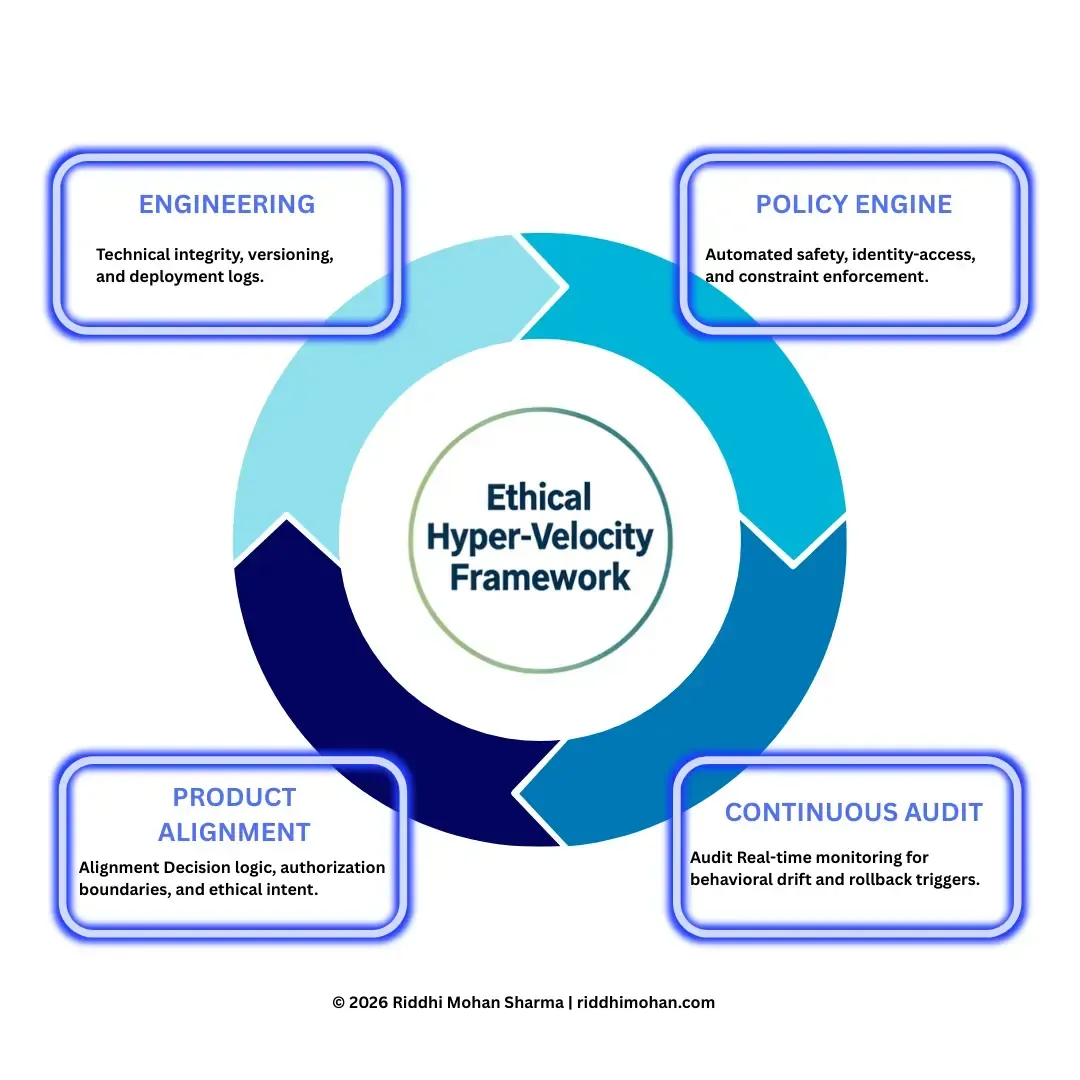
Executive Summary (TL;DR)
Traditional AI governance relies on manual audits and static policy documents. Ethical Hyper-Velocity compiles policy directly into the runtime inference stack, enabling automated, sub-millisecond safety and compliance enforcement.
Who Should Read This
Key Takeaways & Shareable Quotes
“Traditional AI governance produces PDFs. Ethical Hyper-Velocity compiles policy into runtime enforcement.”
“If governance is not built as a runtime primitive, AI agents in production will always trade off safety for speed.”
> Now live on arXiv: May 18, 2026
>
> arXiv:2605.17909 | cs.AI + cs.LO
> 🔗 https://arxiv.org/abs/2605.17909
> DOI: https://doi.org/10.48550/arXiv.2605.17909
This post establishes Ethical Hyper-Velocity (EHV) as the architectural principle that turns AI governance from a manual bottleneck into a system that speeds up secure deployments at enterprise scale.
Each technology era produces an organizing principle that separates organizations that scale from those that stall. In the cloud era, it was build for failure. In the AI era, it is Ethical Hyper-Velocity (EHV).
This approach is demonstrated in my live case study: Architecture Is Policy: Compiling Governance into the AI Stack. It proves that a governance PDF is a checkbox compared to an automated deployment pipeline, highlighting why Governance must scale alongside your Architecture.
Why is traditional AI governance failing?
Traditional frameworks treat compliance as a manual gate, creating a friction-heavy bottleneck that paralyzes enterprise AI. Most organizations treat ethics as a "can we?" question asked too late in the cycle. This episodic approach leads to rework loops and regulatory collisions.
I coined Ethical Hyper-Velocity to name a principle observed across fifteen years of building enterprise systems. Organizations that resolve the speed-governance tension by design consistently outperform those that resolve it by crisis.
>Ethical Hyper-Velocity (EHV) is the maximization of decision and execution speed. We achieve this by shifting governance from a manual gate to an immutable, automated architectural constraint. It is the evolution of systemic trust.
The Catastrophic Scale of Governance Latency (GL)
To understand why manual governance fails, consider the gap between a policy decision and its actual enforcement: Governance Latency (GL).
If the FDA discovers a new neurotoxicity risk for a common oncology drug like Vincristine and updates its approved dosage, a traditional human-in-the-loop hospital committee path takes 14 to 30 days to enforce it at the clinical layer.
When human doctors see 20 patients a day, a 14-day gap is containable. But in an autonomous agentic system (where 5,000 "Physician Twins" generate 100 recommendations per hour, 24/7), a 14-day GL results in:
Even at an extremely low 0.03% error rate, that latency window leaks 50,400 potentially toxic recommendations. AI moves at machine speed; governance must not move at human speed.
By automating policy enforcement at the design phase, organizations eliminate the trust failures that stall Agentic AI deployments. Governance becomes the mechanism of acceleration, much like how intentional product strategy reduces friction.
What is the EHV Core Definition?
EHV is an architectural principle that embeds accountability and compliance directly into system design and deployment pipelines.
Ethical means the system is justifiable to stakeholders, not just legally compliant.
Hyper marks the point where old models are structurally inadequate.
Velocity is a vector: speed plus direction.
Where ZTA ensures the identity is trusted, EHV ensures the agentic action is constrained. This 5 Pillars of Governance Architecture ensures that identity and action are unified. Identity plus Action equals complete governance for Agentic AI.
The Missing Perimeter: Identity vs. Action
NIST SP 800-207 (Zero Trust) secures the Identity (who enters) but remains silent on the Agentic Action (what is executed), creating an visibility gap in autonomous environments. EHV addresses this by serving as the cryptographically enforced "Action Perimeter" that completes the Zero Trust model. This complements Anthropic's Shared Responsibility Model by ensuring that every inference call and tool interaction at the Harness/Tool boundary is bound to a valid, attested policy state.
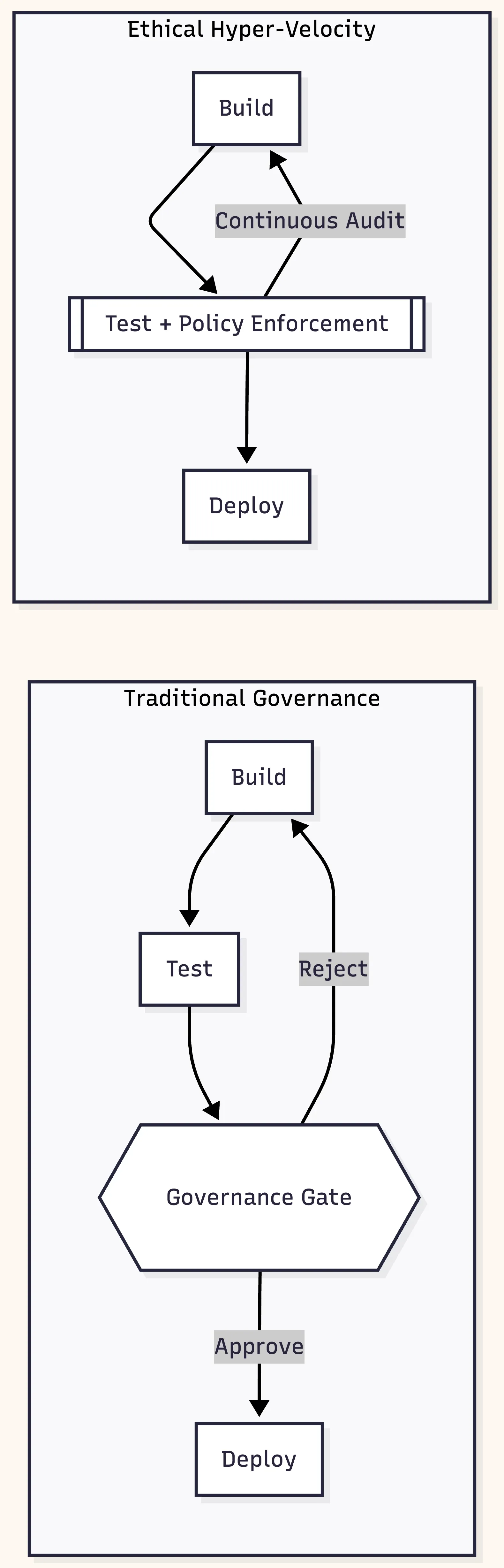
Above: The EHV Pivot replaces reactive "gates" with an automated loop. [EHV Framework © 2026 Riddhi Mohan Sharma]
Architecture is Policy: The Core Three Pillars
EHV moves oversight from the boardroom directly to the execution pipeline. Instead of auditing AI outputs retrospectively, EHV compiles the governing policies into the execution stack itself, making policy violations as computationally impossible as trying to divide by zero.
This architecture stands on Three Core Pillars:
Pillar 1: The Causal CRDT Policy Store (Distributed Sync)
To propagate policy updates across thousands of autonomous agents running in disparate environments, EHV utilizes Conflict-free Replicated Data Types (CRDTs) backed by Vector Clocks for causal ordering (join-semilattice ).
- Policy updates are ordered causally, establishing a monotonic history across nodes.
- When network partitions heal, nodes merge automatically and converge to the causally latest state without a central coordinator.
- This causal clock design removes dependencies on vulnerable physical clocks, mitigating NTP clock-skew attacks (T7).
Pillar 2: Epoch-based Attestation Caching (Speed & Security)
Policy enforcement executes inside a hardware-secure Trusted Execution Environment (TEE) (e.g., Intel SGX or AMD SEV-SNP). However, full remote hardware attestation introduces a 200ms+ latency penalty per call.
EHV resolves this via Epoch-based Attestation Caching:
- Full cryptographic attestation is performed once per epoch (e.g., every 60 seconds).
- Within the epoch, the PEP performs an local integrity hash comparison.
- If the local policy hash matches the epoch quote, it executes at sub-millisecond speeds. If a collision or invalid epoch is detected, the PEP triggers an immediate fail-closed partition lock.
- Epoch Staleness Bound: Under a worst-case partition, a stale policy is active for at most the duration of the epoch (at most 59 seconds), reducing potential exposure from 168 million unverified actions down to actions, representing a 5-order-of-magnitude safety improvement. For emergency overrides, an
EMERGENCY_EPOCH_RESETforces instant re-attestation.
Pillar 3: The PEP in the JIT Compiler (Inline Enforcement)
The Policy Enforcement Point (PEP) is compiled directly into the JIT inference pipeline at the token-generation layer. Before an action can exit the hardware enclave, the PEP evaluates the action tuple against active constraints:
**PERMIT**: The action is verified compliant and proceeds to execution.**DENY**: The action violates policy, hard-halting token generation and routing to a Safe Halt State.**ESCALATE**: The action is ambiguous, suspending execution and routing to human-in-the-loop clinical review.
Grammar-Constrained Decoding (GCD) & Legacy ASEL
Instead of relying purely on parsing unstructured streams after generation, EHV compiles policies into a Deterministic Finite Automaton (DFA) that drives a GPU-accelerated Grammar-Constrained Decoding (GCD) logits processor.
- The PEP masks output logits before sampling, preventing the model from ever generating non-compliant token sequences (Appendix A).
- Legacy unstructured streams are parsed using the Action Schema Extraction Layer (ASEL) for backward compatibility.
- By relocating enforcement to the token-generation layer, GCD eliminates semantic bypass vectors within the grammar's scope, while ASEL remains a scoped compatibility interface.
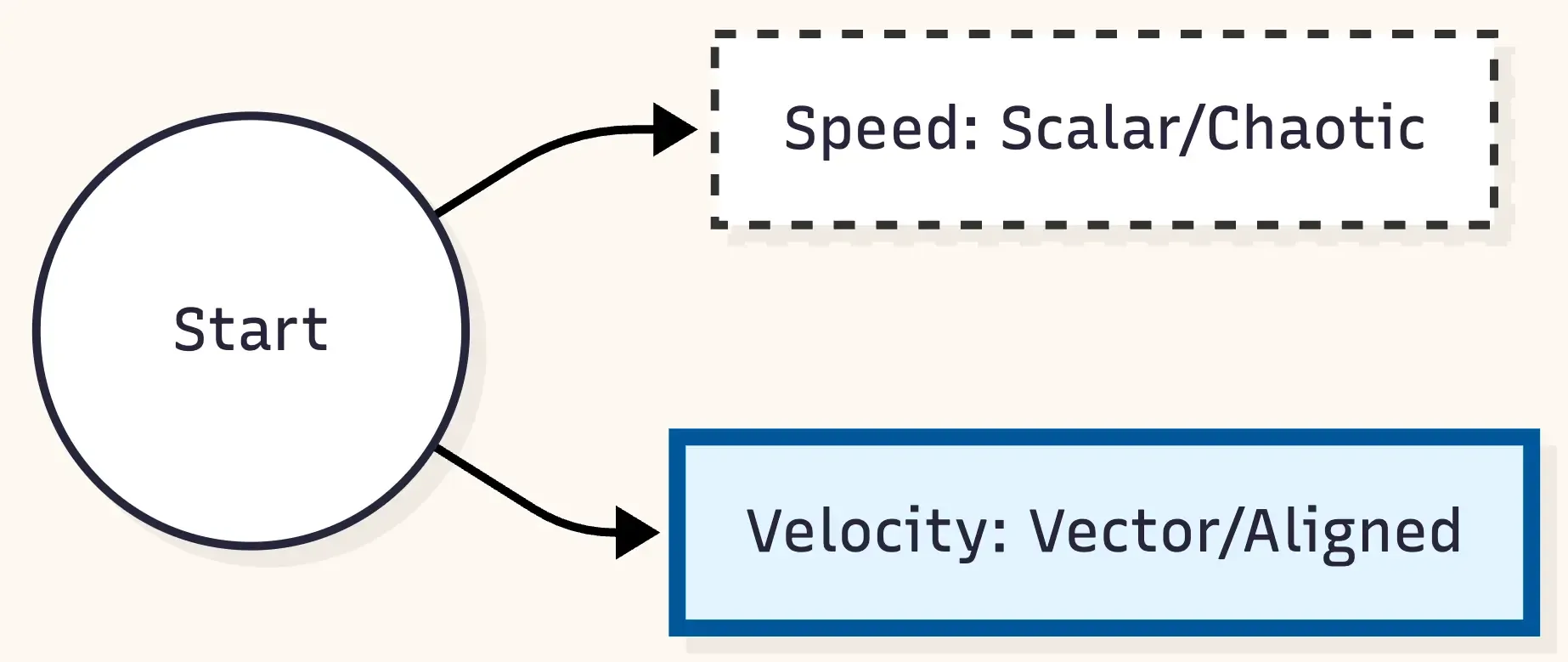
Above: The EHV Continuous Loop validates logic and policy at each build cycle stage. [EHV Framework © 2026 Riddhi Mohan Sharma]
How do we define Governance Latency (GL)?
Governance Latency (GL) is the measurable time interval between a decision event and ethical constraint enforcement:
In traditional architectures, GL spans 14–30 days. EHV drives GL asymptotically to zero, bounded only by local TEE cache validation. This runtime enforcement layer guarantees Sub-millisecond Formal Constraints (SMFD).
For failures or missing TEE environments, Fail-Safe Degraded Mode (FSDM) activates per NIST SP 800-53 SI-17, falling back to out-of-band audits.
TLA+ Formal Verification: Mathematical Invariance
EHV does not rely on probabilistic software filters or hopeful alignment training. Instead, the safety of the architecture is mathematically proven using a TLA+ formal specification evaluated by the TLC Model Checker.
The Safety Invariant ()
The core proof verifies that under all asynchronous interleavings, including network partitions, timing delays, concurrent policy updates, and attestation expirations, an unsafe agentic action can never reach a PERMIT state:
The TLC Model Checker exhaustively evaluated all reachable system states (safety violations: 0, deadlocks: 0, temporal liveness property violations: 0), proving that non-compliant actions are unreachable in the verified bounded operating state space. EHV transforms policy from an external administrative checklist into an immutable system invariant.
What is the Velocity-Ethics Co-Production Principle?
In EHV-compliant systems, deployment velocity and governance integrity are positively correlated. This is a fundamental sign reversal from traditional architectures where governance usually slows down speed.
>
This sign reversal is EHV's core theoretical contribution. Pre-execution constraint enforcement defines the Ethical Action Space within which the agent operates autonomously. This is analogous to traffic law defining the legal operational envelope.
| Framework | Enforcement | GL (Governance Latency) | Agentic AI | Formalism |
|---|---|---|---|---|
| NIST AI RMF | Retrospective Audit | GL = 14–30 Days | None | None |
| ISO 42001 | PDCA Audit | GL = 14–30 Days | None | None |
| EU AI Act | Conformity Assessment | GL Days | None | None |
| ZTA 800-207 | Pre-access (Identity) | N/A | Partial | None |
| EHV v3.0 | Governance-Aware JIT Compiler | SMFD + O(1) | Native | TLA+ Safety Invariants (Depth 8) |
EHV-Runtime: Proof-of-Concept Python Codebase
To demonstrate the runtime enforcement pattern described in the formal specification, we have open-sourced a reference codebase: **ehv-runtime**.
GitHub Repository: riddhimohansharma/ehv-runtime
The codebase translates the TLA+ state machine into standard Python, showcasing how real-time policy updates clamp model outputs in microseconds:
**ehv/sync/**: Implements the causal vector clock CRDT policy store (CausalPolicyStore).**ehv/compiler/**: Provides the decorator-based Policy Enforcement Point (PEP) executing inside simulated enclave boundaries.**examples/**: Features a clinical dosage case study and microsecond latency benchmark.
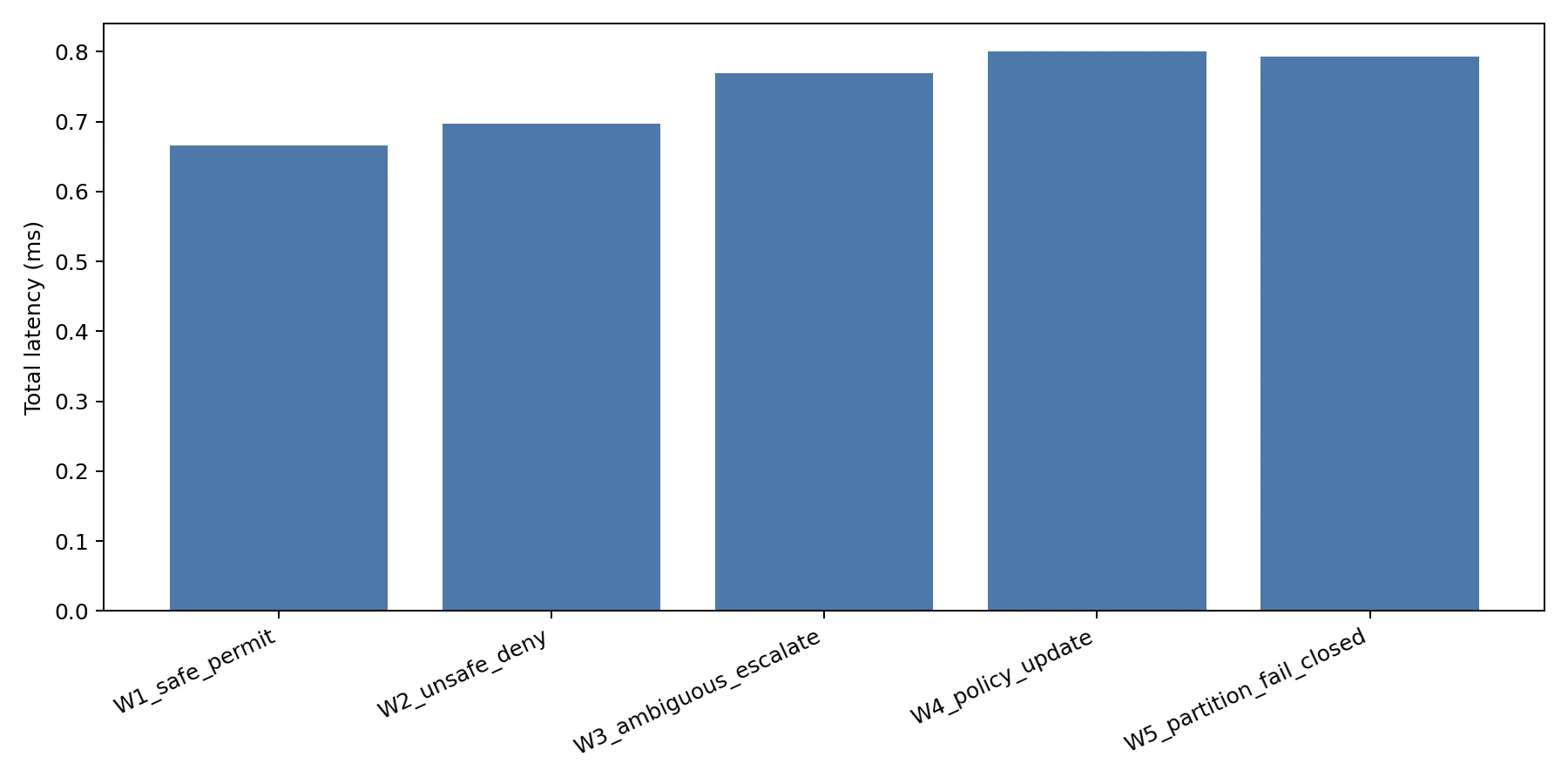
Across 10,000 governed function calls, the enforcement decorator adds negligible computational overhead (~1μs per call), demonstrating that pre-execution safety constraint validation is feasible at native execution speeds.
Visual Performance Projections
Simulated latency and throughput profiles on AMD SEV-SNP:
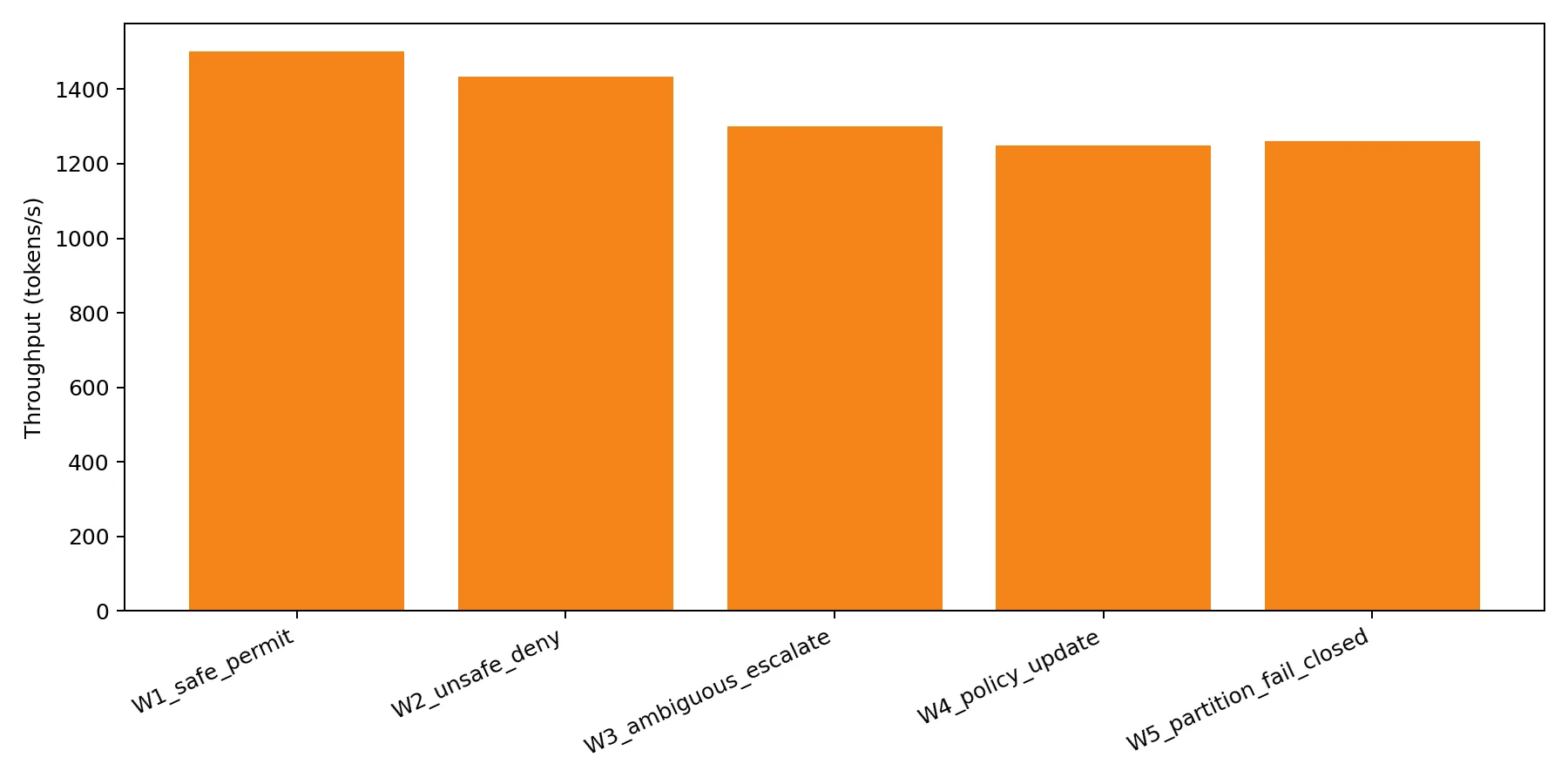
How does EHV impact M&A? Introducing the GBOM
In high-velocity M&A, governance debt is often invisible until it is catastrophic. EHV introduces the GBOM (Governance Bill of Materials), creating a level of transparency previously impossible in black-box AI systems.
EHV provides a "Policy-Action Atomic Binding": a cryptographic receipt that proves exactly which policy version governed a specific agent decision. This is the "Ultimate Due Diligence" tool for C-Suite leaders; it allows an acquiring CEO to verify each autonomous decision made by a startup's agentic stack against historical regulatory requirements. An AI stack that cannot provide a GBOM is a liability.
The differentiator for the next three years is architectural trust. This is critical in regulated verticals like Healthcare AI. The shift to preemptive neurological prediction highlights the need for continuous oversight.
Organizations that embed this principle today will compound their deployment advantage. Those that defer it will carry the growing cost of unauditable decisions. Trust and speed are not trade-offs; they are twins.
Architectural Friction Point
This approach holds when the underlying compute hardware supports Confidential Computing (TEE). It encounters limits when the system runs in non-TEE environments, where the SMFD (Sub-millisecond Formal Constraints) loop is vulnerable to runtime injection, requiring fallback to out-of-band audits that recreate Governance Latency.
Research & Standardization Roadmap
The transition from theory to industrial standard is underway. The following milestones represent the current trajectory for EHV:
- EHV Preprint (v3.0): A full technical paper documenting sub-millisecond formal constraints (SMFD) and GBOM specs. Published at arXiv:2605.17909.
- Standards Submission: Submission of the EHV Governance-Aware JIT specification to IEEE for formal review.
- Reference Build: Open-sourcing a reference architecture for a healthcare-adjacent agentic system demonstrating sub-millisecond policy clamp-downs.
- Code Artifacts: Release of TLA+ safety invariants and the
ehv-compileCLI tool for build-time policy enforcement.
EHV Version History
- v1.0 (March 9, 2026): Original framework published. Introduced EHV concept and Three Pillars.
- v2.1 (March 16, 2026): Added formal definitions, Physician Twin architecture, and SMFD.
- v2.2 (April 3, 2026): Introduced GBOM, Governance-Aware JIT Compiler, and Epoch-based Attestation.
- v3.0 (May 17, 2026): Aligned with the formal arXiv preprint (arXiv:2605.17909v2), TLA+ verification specs, ASEL-to-GCD pivot, causal vector clock CRDT protocol, and open-source
ehv-runtimePoC release.
Cite This Work
> Sharma, R. M. (2026). Ethical Hyper-Velocity (EHV): A Hardware-Rooted Zero-Trust Runtime Enforcement Architecture for Agentic AI Systems. arXiv preprint arXiv:2605.17909. https://arxiv.org/abs/2605.17909
>
> ORCID: 0009-0000-3757-5818
> DOI: https://doi.org/10.48550/arXiv.2605.17909
If your build bridges enterprise AI and identity governance, let's talk.
Cite This Work
Formal Academic Reference
"Sharma, Riddhi Mohan. (2026). Ethical Hyper-Velocity (EHV): Compiling Governance into the AI Inference Stack. riddhimohan.com, March 9, 2026. /blog/ethical-hyper-velocity-ehv-compiling-governance-into-ai-inference-stack"
This research is open for academic citation and peer-review. Established to support the advancement of AI Governance and Industrial Ethics.
Related Insights

Architecture Is Policy: Compiling Governance into the AI Stack
Building this portfolio offered a live use-case of Ethical Hyper-Velocity. The focus is on a three-tier governance architecture that manages the automation of pre-build guardrails pertaining to consistent, reliable standards, performance budgets, and the professional integrity of the builders.

Quantum Infrastructure: Why Governance Scales Before Qubit Fidelity
On June 12, 2026, I presented as an invited speaker at the DOE Office of Science SCAC Quantum Subcommittee Town Hall. The three observations from my research focused on program design rather than qubit fidelity.
HPPIE: RAG Without Persona Modeling Fails Patient Clinical Relevance
A RAG pipeline that returns the same results for a 25-year-old athlete and a 70-year-old with a diabetic condition has not solved relevance. It has transferred the burden of clinical filtering to the patient. HPPIE fuses persona modeling directly into retrieval to close that gap.

Identity Debt Compounds: What 12 Healthcare Acquisitions Taught Me About Day One
Identity integration starts post-close. That is not the problem. The problem is whether the platform was built for serial acquisition before the first deal closed.

Riddhi Mohan Sharma
Senior Technology Leader. Global Identity Architecture. M&A Technology Integration. AI Strategy.
Senior Technology Leader specializing in Global Digital Identity Architecture and M&A Technology Integration. Track record across multi-million dollar P&L, AI strategy, healthcare compliance (GDPR/HIPAA), and Identity platforms scaled to 3.5M+ users.
Framework Attribution
Disclaimer:The views, frameworks, and architectures presented here (including Architecture Is Policy / Ethical Hyper-Velocity and HPPIE) are my personal thoughts and original syntheses. They are inspired by and draw lessons from my broad enterprise-scale research and experience in healthcare identity, M&A integration, and AI governance. They do not represent the views, policies, or practices of my employer and are not based on any specific proprietary information, internal systems, code, metrics, or confidential details from my current or past roles. All examples and implementations are generalized or self-hosted on this personal site.