
Executive Summary (TL;DR)
Healthcare M&A fails on identity integration. Reducing post-close friction requires building systems prepared for multi-tenant, federated identity from day one.
Who Should Read This
Key Takeaways & Shareable Quotes
“Identity integration starts post-close, but identity architecture must start pre-deal.”
“Identity debt in healthcare acquisitions compounds faster than financial debt.”
The observations, patterns, and frameworks in this article reflect my personal professional experience and independently developed perspective. They do not represent the views, systems, or practices of any current or former employer. No confidential, proprietary, or client-specific information is disclosed.
[!NOTE] Keynote Address & Framework Update (July 2026): Delivered the keynote speech: "When Login Failure Is Not an Option: Three Pre-Close Identity Architecture Decisions", introducing the Identity-First Resilience Model to 200+ IAM leaders, CISOs, and practitioners at the New York Identity, Authentication & Access Management Summit. Read the Keynote Reflection on LinkedIn.
Over 50% of acquirers destroy shareholder value post-close. Cybersecurity failures alone reduce deal valuations by 15–20%.
Identity integration is the largest unpriced cybersecurity liability in regulated M&A and it rarely appears in the LOI.
Most regulated acquisitions close on paper. Identity is where they close in reality. Or they don’t.
The gap isn’t operational. It’s a platform readiness failure.
Identity integration starts after the deal closes.
In twelve healthcare acquisitions, not once did the identity team get involved before close. Never. Zero visibility.
That is not an oversight. It is a structural feature of how deals get done. Due diligence teams treat identity as a valuation risk item, not a Day One operational cost.
It never makes the LOI checklist with teeth. This lack of foresight represents the definitive intersection where strategic intent meets the brutal operational reality of technical debt stacking.
Prepare early.
Winning requires the Intentional Design of the identity substrate long before the first letter of intent is signed by the board.
In the early deals, the process typically started after close. In the later ones, the involvement window shifted slightly earlier.
But integration was always a post-close workstream. That is not the problem.
The problem is what happens when integration starts and there is no platform to absorb the acquired entity. No standard onboarding path.
Just a blank whiteboard and a twelve-month timeline to build something custom. You rebuild for this deal the same way you rebuilt for the last one.
I ran identity integration across twelve healthcare acquisitions. The pattern that separated the fast integrations from the slow ones was never team size.
It was whether the identity platform had been designed for serial acquisition before that particular deal started. Platform over project. Always.
On July 23, 2026, I delivered my keynote speech: "When Login Failure Is Not an Option: Three Pre-Close Identity Architecture Decisions", introducing the Identity-First Resilience Model to 200+ IAM leaders, CISOs, and practitioners at the New York Identity, Authentication & Access Management Summit (Read the Keynote Post on LinkedIn).
The core argument: Non-Human Identity (NHI) Governance is a pre-close M&A risk, not a post-close IT task.
In large-scale regulated environments, authentication failure is not a recoverable UX moment; it is a patient safety and business resiliency problem.
To formalize this, I introduced the Identity-First Resilience Model, built around three pre-close decisions that determine whether an M&A integration survives contact with reality:
- 01: Jurisdiction Mapping
- 02: Federated Defaults
- 03: Access Sequencing
Get these three wrong before close, and you are not fixing an IT gap post Day-1: you are managing an incident.
If you have ever inherited an identity environment from an acquisition and had to determine what was in place: this is the conversation we need to be having earlier in deal cycles, not after.
The Platform Question
The readiness of an identity platform is determined by its ability to absorb a new entity without structural modification. In the early deals, the standard playbook for assessing the target's internal identity systems was followed.
Each deal felt distinct. Different technology stacks across on-prem, cloud, and hybrid environments.
Different regulatory requirements. Different teams across three continents.
With each integration, the methodology iterated. What worked stayed.
What failed got cut. The playbook matured.
By the fourth deal, it had absorbed enough patterns that it stopped looking like a checklist. It started looking like a platform.
By the fifth, the architecture underneath was doing work that used to require custom engineering. Standardized onboarding.
The matured platform changed the math. Integration timelines compressed from twelve-plus months to under six.
Because the architecture had absorbed enough iterations to handle new iterations without structural modification. Efficiency is engineered.
The Strategy Fork: Consolidate or Federate?
While common wisdom assumes consolidation is always the goal, in healthcare M&A, it frequently is not. Acquired provider networks or independent clinical brands often require operational independence to maintain clinical workflows.
Naming this decision at the due diligence phase determines your identity roadmap:
- The Consolidation Path: Moving acquired clinicians into your core IdP. Use this when the provider network is being fully absorbed: same EHR, same credentialing, same payer contracts. A unified clinical identity is the mandated end state.
- The Federation Path: Establishing a trust relationship with the acquired IdP. Use this when provider networks require clinical autonomy, allowing doctors to maintain existing workflows while sharing data with the parent.
The trigger for consolidation is not cost; it is clinical unification. When there is genuinely one care delivery model post-merger, consolidate. If that is not yet true, forcing HCP identity consolidation creates catastrophic access risk at the point of care.
Identity Debt Is Not Technical Debt
Technical debt accumulates linearly. Skip a refactor, pay a maintenance cost.
Identity debt compounds. It explodes.
While standard technical debt behaves like a manageable interest-bearing loan that can be paid down through periodic refactoring, identity debt acts like a toxic derivative. It exponentially increases in complexity with each single subsequent organizational integration. Scale is brittle.
This compounding complexity eventually limits the scalability of the system. The cost of maintenance begins to exceed the value of the platform itself.
Break the cycle. Build for scale. Each deal matters.
Each acquisition that uses a "temporary bridge" adds a multiplier to the next deal. A manual credential sync here.
The bridge from acquisition two becomes a dependency for acquisition five. The dependency from five becomes a constraint on eight.
These widely-reported incidents illustrate a structural pattern where inherited identity platforms lack standardized absorption paths. In 2016, Marriott acquired Starwood Hotels, inheriting the compromised reservation infrastructure post-acquisition. In 2022, UnitedHealth Group acquired Change Healthcare, where inherited remote-access portals faced access challenges.
While publicly reported as human access failures, these incidents underscore the broader risk of failing to govern legacy technology in complex M&A environments, where inherited directories are not subject to immediate post-acquisition review. Both cases highlight the need for a standardized platform capable of absorbing inherited identity infrastructure.
Compliance Does Not Merge
HIPAA requires indefinite retention of medical access records. GDPR requires deletion upon request.
These are not policy differences. They are architectural contradictions.
A single Global Identity PaaS: Scaling Governance for 3.5M+ Professionals database cannot satisfy both. The credential store must be separated by jurisdiction.
The routing decision must happen at authentication time. Not at provisioning time.
This separation was built into the identity platform as a design constraint from the start. We did not add it as a reaction to a compliance incident.
The compliance guardrails were architectural features of the platform, not post-integration patches. Across twelve acquisitions, this separation proved to be the only sustainable path.
That separation cannot be retrofitted. If the identity layer was not built for jurisdictional routing, the gap is not a policy problem.
The Three Questions That Define Platform Readiness
Question One. Can the identity platform absorb this entity without custom integration?
If the answer requires building a new connector, the timeline includes engineering work not on the deal sheet. That is a platform architecture gap.
Question Two. How many temporary identity bridges from prior acquisitions are still running? The number is always higher than the team admits.
By the eighth acquisition, the bridges consume more operational hours than the platform they were bridging to.
If the platform serves US users under HIPAA and EU users under GDPR, jurisdictional separation must exist before the first cross-border authentication. This is a platform capability.
Question Three. Does the identity architecture govern Non-Human Identities (NHI)?
In modern healthcare, service accounts, API keys, and device identities often outnumber human users 10-to-1. If your platform does not have a standardized path for rotating service account credentials or vaulting API keys for acquired entities, you have not integrated the identity layer. You have just inherited a vulnerability.
What Execution Teaches That Planning Does Not
Across twelve deals, the single highest-cost decision was not technical. It was scoping.
One integration required re-scoping twice in the first thirty days. The original scope looked clean on paper.
Defining the minimum integration required determined whether the integration finished in months or dragged past a year. The discipline is in building less.
Execution is the real planning. Challenge assumptions.
In a serial acquirer, identity integration is a core strategic priority. If integration strategy remains unresolved post-close, the governance model is the constraint to address first.
Three Things to Do Before Q3
Run a temporary-bridge audit this week, but apply a Triage Model. List each identity bridge and shared service account still running, then score them against a Risk-Velocity Matrix:
| Priority | Criteria | Action |
|---|---|---|
| P1: Critical | Lateral movement potential, no MFA, high privilege. | Immediate Decommission |
| P2: High | Shared credentials, legacy protocols (SAML 1.1/NTLM). | 30-Day Hardening |
| P3: Routine | Redundant sync, orphaned directory, non-critical apps. | Quarterly Cleanup |
McKinsey estimates that 30 to 50 percent of M&A deal value is lost to IT integration failures. Temporary bridges, those P1 and P2 items, are where that value leaks through silent, compounding debt.
Add identity platform readiness to your M&A checklist. Not the target's architecture. Yours.
Before the next deal closes, answer: can the identity platform absorb an unknown entity without custom engineering? The gap was not in assessing the target.
Confirm that identity integration is a mandate. If it is still being debated post-close, the governance model is the bottleneck.
Marriott ran Starwood's compromised reservation network for two years post-acquisition (four years total) because identity was treated as an operational workstream. It was a governance failure.
Questions this work raises
What happens when the acquired entity has a fundamentally incompatible identity provider? Integration timelines extend.
The question is whether the extension was anticipated. Anticipating it costs planning time.
How do you handle resistance from acquired organizations?
The most effective approach is showing the operational cost of the last three temporary bridges, which speaks louder than any architectural debate.
Views are my own.
Technical Index
- Framework Version: 2.0.0 (Identity-First Resilience Model)
- Governance Architecture: 5 Pillars of Governance Architecture
- Technical Build: Case Study: Architecture Is Policy establishes the automated guardrails mentioned above.
Related Insights

Quantum Infrastructure: Why Governance Scales Before Qubit Fidelity
On June 12, 2026, I presented as an invited speaker at the DOE Office of Science SCAC Quantum Subcommittee Town Hall. The three observations from my research focused on program design rather than qubit fidelity.
HPPIE: RAG Without Persona Modeling Fails Patient Clinical Relevance
A RAG pipeline that returns the same results for a 25-year-old athlete and a 70-year-old with a diabetic condition has not solved relevance. It has transferred the burden of clinical filtering to the patient. HPPIE fuses persona modeling directly into retrieval to close that gap.
Architecture Is Policy: Compiling Governance into the AI Stack
Building this portfolio offered a live use-case of Ethical Hyper-Velocity. The focus is on a three-tier governance architecture that manages the automation of pre-build guardrails pertaining to consistent, reliable standards, performance budgets, and the professional integrity of the builders.
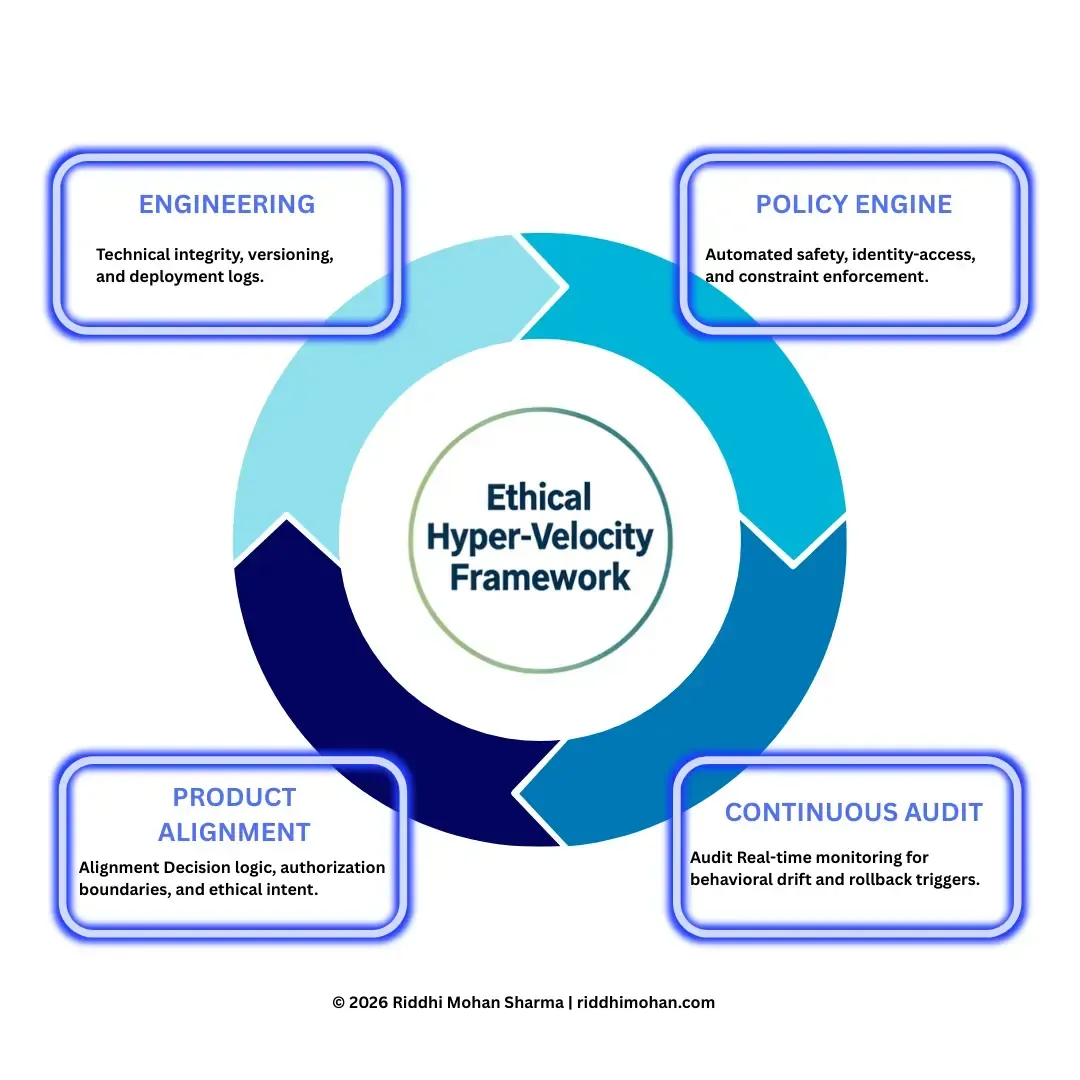
Ethical Hyper-Velocity (EHV): Compiling Governance into the AI Inference Stack
EHV is not a 'policy framework' but a Governance-Aware JIT Compiler that eliminates the 'Governance Latency' inherent in ISO 42001 and human-in-the-loop audits. By compiling governance directly into the inference stack, we move from reactive compliance to proactive, sub-millisecond enforcement.

Riddhi Mohan Sharma
Senior Technology Leader. Global Identity Architecture. M&A Technology Integration. AI Strategy.
Senior Technology Leader specializing in Global Digital Identity Architecture and M&A Technology Integration. Track record across multi-million dollar P&L, AI strategy, healthcare compliance (GDPR/HIPAA), and Identity platforms scaled to 3.5M+ users.
Framework Attribution
Disclaimer:The views, frameworks, and architectures presented here (including Architecture Is Policy / Ethical Hyper-Velocity and HPPIE) are my personal thoughts and original syntheses. They are inspired by and draw lessons from my broad enterprise-scale research and experience in healthcare identity, M&A integration, and AI governance. They do not represent the views, policies, or practices of my employer and are not based on any specific proprietary information, internal systems, code, metrics, or confidential details from my current or past roles. All examples and implementations are generalized or self-hosted on this personal site.