This post proves that the accidental roadmap is a failure of Choice Architecture. We provide a 4-pillar framework to design user decisions for non-linear growth.
Strategy is design. Design is destiny.
Build with intent. We must architect for the outcome that logic cannot guarantee alone in a world of complex user behavior.
Outcome wins. Build.
Stop reviewing feature requests. The most devastating failure in product strategy is not poor execution.
It is the Accidental Roadmap.
This is a list of features that satisfy immediate demands but fail to engineer guaranteed user outcomes. Outcome over output.
Always build the engine of intent. Intent is life.
This happens because product leaders mistakenly prioritize Visible Logic over the true engine of influence: Invisible Architecture. This failure challenges the fundamental premise of standard product research models.
Why does the Accidental Roadmap kill product velocity?
While Jobs-to-be-Done (JTBD) identifies why a customer hires a product, it ignores the behavioral science that determines if the customer will successfully finish the job.
We propose the Canonical Thesis (CT): Intentional Product Strategy is the mastery of Choice Architecture. Strategy is behavioral architecture.
Choice Architecture serves as the behavioral layer that guarantees JTBD fulfillment. It is the secret geometry of the user experience.
Daniel Kahneman confirmed that hidden cues often influence us more than obvious ones. They dictate our actions before the rational brain even registers a choice.
You cannot resist what you do not notice. Silence is loud.
The goal is not to persuade the user. It is to bypass the rational brain completely through precise environmental design.
Product design is psychology in disguise. You can choose your Choice Architect, or the environment will choose for you.
How do global leaders engineer user environments?
The world's most valuable companies don't launch features; they execute deliberate acts of architecture that shape user behavior at scale. Netflix auto-plays the next episode, removing the decision to stop.
Amazon removed hesitation with one-click checkout, creating zero pause and zero doubt. Google removed distraction with a blank homepage, focusing all energy on the singular intent of search.
Most companies allow environmental chaos to choose for their users. This leads to high drop-off during onboarding and low engagement on key actions.
These are not failures of logic. They are failures of Intentional Design.
What are the 4 Pillars of Intentional Design?
To shift to a system of engineered outcomes, product leaders must apply four pillars.
Each application of the framework requires a non-linear commitment to the mastery of decision geometry across each single touchpoint that defines the modern digital customer experience in a competitive sector. Trust is earned.
Pillar 1 is to Frame the First Step. Design the initial action to deliver instant value, making the subsequent investment of time feel justified.
Pillar 2 is to Guide Attention. Use defaults, placement, and contrast to steer the user's finite energy toward the desired action.
The user is not being told what to do. They are being guided by the environment.
Pillar 3 is to Reduce Friction. Each extra click and unnecessary field is an exit ramp.
Radical elimination of cognitive load is essential. In security, this means a centralized cryptographic model that removes password friction.
How do we prime user confidence?
Pillar 4 is to Prime Confidence. Create early, non-trivial wins that shape the perception of the journey.
Priming is an early deposit of trust. It makes the user confident the product will succeed.
Trust is earned. Trust is engineered.
Architecture is the silent partner. Success is the inevitable result.
An app that immediately imports external data ensures the user feels powerful and competent from the initial minute. By the time logic kicks in, the architecture has already made the decision.
The difference between failure and a 10x strategy is not effort or funding: it is Intentionality. The path to non-linear growth requires the CEO to re-architect how decisions are made internally and externally.
What is the Mandate for next Strategy?
Sunset all feature requests that do not explicitly improve one of the 4 Pillars. The priority must shift from "what can we build" to "what behavioral resistance can we dissolve."
This focus on behavioral outcomes is driving the neuro-prediction pivot, shifting R&D toward preemptive health monitoring. Re-architect all onboarding flows to assume the customer is already primed.
Remove any explanatory text aimed at novices to filter out unnecessary cognitive load. Establish a system to quantitatively track the ROI of friction reduction.
Each removed decision point must be assigned a measurable value. Metrics matter.
How do we codify the Canonical Thesis?
Establish the Canonical Thesis of Choice Architecture as the non-negotiable standard for all product review meetings. This transforms the roadmap from a scatterplot of ideas into a guaranteed sequence of intentional user outcomes.
Engineering for the future isn't about more features; it's about better architecture. Apply this framework to your strategy now to secure the 10x growth your product deserves.
Strategic Friction Point
The model fails when applied to specialized industrial tools where high cognitive load is a prerequisite for safety-critical precision. In these contexts, radical friction reduction can lead to 'autopilot' errors that compromise technical integrity.
Technical Index
- Framework Version: 1.2.5 (Decision Engineering)
- Pillars: Frame, Guide, Reduce, Prime
- Archival Priority: Industrial Standard
- Status: Verified Deployment
Cite This Work
Formal Academic Reference
"Sharma, Riddhi Mohan. (2025). Choice Architecture: 4 Pillars to Kill the Accidental Roadmap. riddhimohan.com, August 24, 2025. /blog/choice-architecture-4-pillars-kill-accidental-roadmap"
This research is open for academic citation and peer-review. Established to support the advancement of AI Governance and Industrial Ethics.
Related Insights

Identity Debt Compounds: What 12 Healthcare Acquisitions Taught Me About Day One
Identity integration starts post-close. That is not the problem. The problem is whether the platform was built for serial acquisition before the first deal closed.

Architecture Is Policy: Compiling Governance into the AI Stack
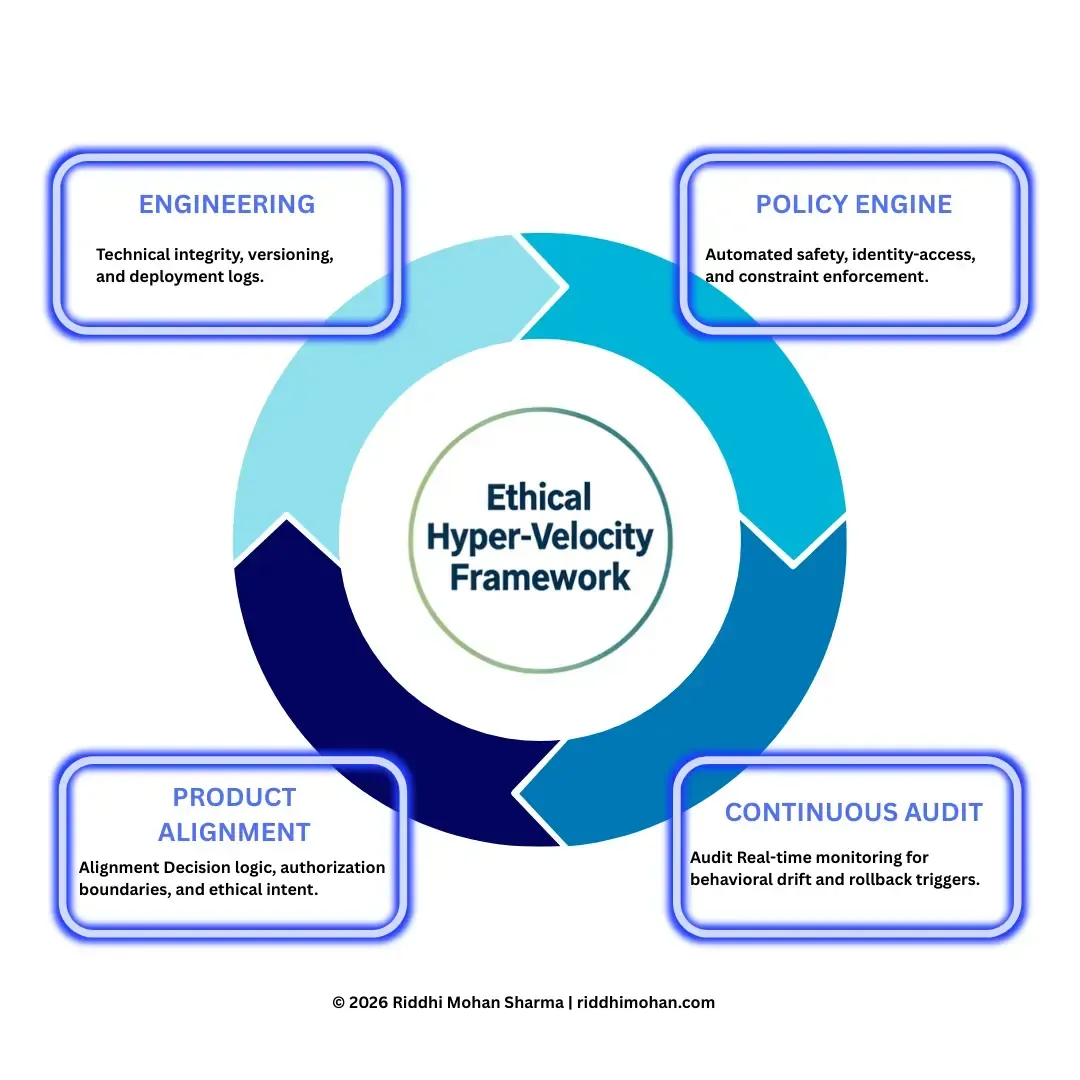
Building this portfolio offered a live use-case of Ethical Hyper-Velocity. The focus is on a three-tier governance architecture that manages the automation of pre-build guardrails pertaining to consistent, reliable standards, performance budgets, and the professional integrity of the builders.
HPPIE: RAG Without Persona Modeling Fails Patient Clinical Relevance
A RAG pipeline that returns the same results for a 25-year-old athlete and a 70-year-old with a diabetic condition has not solved relevance. It has transferred the burden of clinical filtering to the patient. HPPIE fuses persona modeling directly into retrieval to close that gap.
Ethical Hyper-Velocity (EHV): A Hardware-Rooted Zero-Trust Runtime Enforcement Architecture for Agentic AI Systems
EHV is not a 'policy framework' but a Governance-Aware JIT Compiler that eliminates the 'Governance Latency' inherent in ISO 42001 and human-in-the-loop audits. By compiling governance directly into the inference stack, we move from reactive compliance to proactive, sub-millisecond enforcement.

Riddhi Mohan Sharma
Engineering Leader. Global Identity Architecture. M&A Technology Integration. AI Strategy.
Engineering Leader specializing in Global Digital Identity Architecture and M&A Technology Integration. Track record across multi-million dollar P&L, AI strategy, healthcare compliance (GDPR/HIPAA), and Identity platforms scaled to 3.5M+ users.
Framework Attribution
Disclaimer:The views, frameworks, and architectures presented here (including Architecture Is Policy / Ethical Hyper-Velocity and HPPIE) are my personal thoughts and original syntheses. They are inspired by and draw lessons from my broad enterprise-scale research and experience in healthcare identity, M&A integration, and AI governance. They do not represent the views, policies, or practices of my employer and are not based on any specific proprietary information, internal systems, code, metrics, or confidential details from my current or past roles. All examples and implementations are generalized or self-hosted on this personal site.