Executive Summary (TL;DR)
SSO is not a tool; it is the policy-driven perimeter. Modernizing identity infrastructure requires moving from static SAML integrations to a dynamic, multi-pillar governance architecture.
Who Should Read This
Key Takeaways & Shareable Quotes
“Identity is the only perimeter left. Treat Single Sign-On as governance, not plumbing.”
“If you are running SAML like it's 2010, you have identity debt, not security.”
Identity is the cornerstone of modern industrial intelligence. Trust is non-negotiable.
This post establishes the 5 Pillars of Governance Architecture. The governance model demands a programmatic architectural reset required for operational Zero Trust. Each architectural decision made today determines the resilience of the digital perimeter for the next decade.
For two decades, the security world tolerated the most expensive vulnerability: the password. The global digital economy was built on the brittle foundation of human-managed character strings.
This resulting architectural flaw has become the enterprise's most persistent structural risk. It manifests as an immense, non-linear operational cost, where constant IT helpdesk tickets drain resources and each new application introduces a new point of security vulnerability.
Why is legacy identity architecture failing?
The impossibility of auditable, instantaneous account revocation makes legacy architecture unsustainable. Revoke instantly.
It demands a mandatory pivot from a distributed model of authentication to a centralized model of delegated trust. The solution is not a new firewall.
It is the establishment of a centralized Identity Provider (IdP). This IdP acts as a non-negotiable economic foundation for the hyper-integrated cloud economy.
This Federated Identity necessity directly extends the promise of legacy specifications. This shift is a strategic imperative for the modern enterprise.
Executive leadership must recognize that this transition requires five distinct, generationally-linked pillars. They are not interchangeable.
They constitute a comprehensive governance architecture for varying levels of trust. Secure the perimeter. This model was pressure-tested during the deployment of the Global Identity PaaS: Scaling Governance for 3.5M+ Professionals.
What is the 5 pillars of Identity Governance Architecture?
The architecture is composed of five pillars: SAML, OAuth, OIDC, Zero Trust Policy, and the Future Layer. Each serves a distinct strategic function.
SAML 2.0 remains the primarily tool for Authentication (Who) using XML standards. It is best suited for Enterprise B2B and High-Compliance Web SSO.
OAuth 2.0 is focused on Authorization (What) using JSON/JWT standards. It is indispensable for API Access Delegation and securing the API surface.
It enables Least Privilege security by granting precise, limited permissions to services.
OIDC is the accelerator layer for Modern Web, Mobile SSO, and Microservices. Built on top of OAuth 2.0, it delivers simplicity and velocity for rapid deployment, acting as the lightweight identity layer for modern service architectures.
Zero Trust via Tokens is the fourth pillar, enforcing strict policy through ID Token versus Access Token separation.
The fifth pillar is the Future Layer. It incorporates FIDO2, WebAuthn, SCIM, and Self-Sovereign Identity.
How do we navigate the Velocity-Security tension?
The current strategic tension centers on the necessary migration from the established SAML model to the agile OIDC standard. Conventional wisdom suggests SAML remains the gold standard.
First principle deconstruction reveals that the operational tax of SAML now exceeds its marginal security benefit. The verbosity and complexity make it a technical debt issue.
Expensive certificate rotation is a risk, not a preference. The imperative is a managed transition. Each delay in decommissioning legacy SAML endpoints represents a cumulative architectural risk.
Each enterprise must migrate. Move from burdensome SAML to lightweight OIDC for all new applications.
Simplicity is a weapon. The stability and simplicity of OIDC are the new economic constants.
An expired SAML certificate can cause hours of disruptive downtime.
How does the token become the new perimeter?
The cost of a full OIDC transformation is an investment in operational resilience and developer velocity. This is not just a technical shift, but a necessary intentional product strategy to reduce friction.
Consolidating trust into a single IdP introduces a potential Single Point of Failure (SPOF). SSO protocols do not replace Zero Trust Architecture (ZTA); they enable it. The defense against this risk is to deploy Continuous Adaptive Security.
The verifiable token becomes the enforcement tool for ZTA policy. A policy must be codified. For a technical build of this model, see the Case Study on automated guardrails.
ID Tokens are for authentication, while Access Tokens are for authorization. No exceptions are permitted in a high-fidelity architecture.
What is the 10-Year trajectory for identity?
The 10-year strategy looks beyond current SSO models to adopt passwordless authentication standards like FIDO2/WebAuthn. Eliminating the password strengthens the IdP's initial authentication signal, while SCIM automates user provisioning across all applications. Just as decoding cognitive signals leverages pattern recognition, identity through FIDO2 provides a more reliable verification signal.
The long-term, asymmetric bet is in Self-Sovereign Identity via Verifiable Credentials (VCs). This shift transforms the user from a subject of the IdP into a holder of their own cryptographic identity.
It fundamentally rewires the model of enterprise trust. Decentralize.
The Mandate for the Modern Executive
Your mandate is clear: Audit Your Trust, Invest in the Pivot, and Embrace Continuous Security. SSO is the governance architecture managing the organization's most valuable asset.
Rigorously enforce the Principle of Least Privilege by auditing OAuth scopes and eliminating overly permissive grants. Treat the phased migration of legacy SAML applications as an ongoing technical debt reduction project, similar to how unchecked identity debt compounds across healthcare acquisitions. These SSO tokens serve as the cryptographic foundation for Zero Trust.
This vocabulary is put to work in my Global Identity PaaS: Scaling Governance for 3.5M+ Professionals case study and in HPPIE.
In these systems, identity becomes a clinical retrieval primitive. The era of the insecure password is over.
By mastering this tension, an executive moves from managing perimeter security to becoming an Architect of a secure digital future. Build the future.
Architectural Friction Point
This approach holds when services support modern REST APIs and token standards. It encounters limits when the enterprise must maintain legacy support for SOAP-based web services that cannot be upgraded to OIDC/OAuth2, and the 'SSO Proxy' introduced to bridge the gap becomes a single point of failure that limits the distributed resilience of Zero Trust.
Technical Index
- Framework Version: 1.0.0 (Baseline Architecture)
- Governance Pillars: SAML, OAuth, OIDC, Zero Trust, Future Layer
- Archival Priority: Established (Dec 2025)
- Status: Verified Strategy
Cite This Work
Formal Academic Reference
"Sharma, Riddhi Mohan. (2025). SSO Is Not Technology: 5 Pillars of Governance Architecture. riddhimohan.com, December 1, 2025. /blog/sso-not-technology-5-pillars-governance-architecture"
This research is open for academic citation and peer-review. Established to support the advancement of AI Governance and Industrial Ethics.
Related Insights
Identity Debt Compounds: What 12 Healthcare Acquisitions Taught Me About Day One
Identity integration starts post-close. That is not the problem. The problem is whether the platform was built for serial acquisition before the first deal closed.
Quantum Infrastructure: Why Governance Scales Before Qubit Fidelity
On June 12, 2026, I presented as an invited speaker at the DOE Office of Science SCAC Quantum Subcommittee Town Hall. The three observations from my research focused on program design rather than qubit fidelity.
Architecture Is Policy: Compiling Governance into the AI Stack
Building this portfolio offered a live use-case of Ethical Hyper-Velocity. The focus is on a three-tier governance architecture that manages the automation of pre-build guardrails pertaining to consistent, reliable standards, performance budgets, and the professional integrity of the builders.
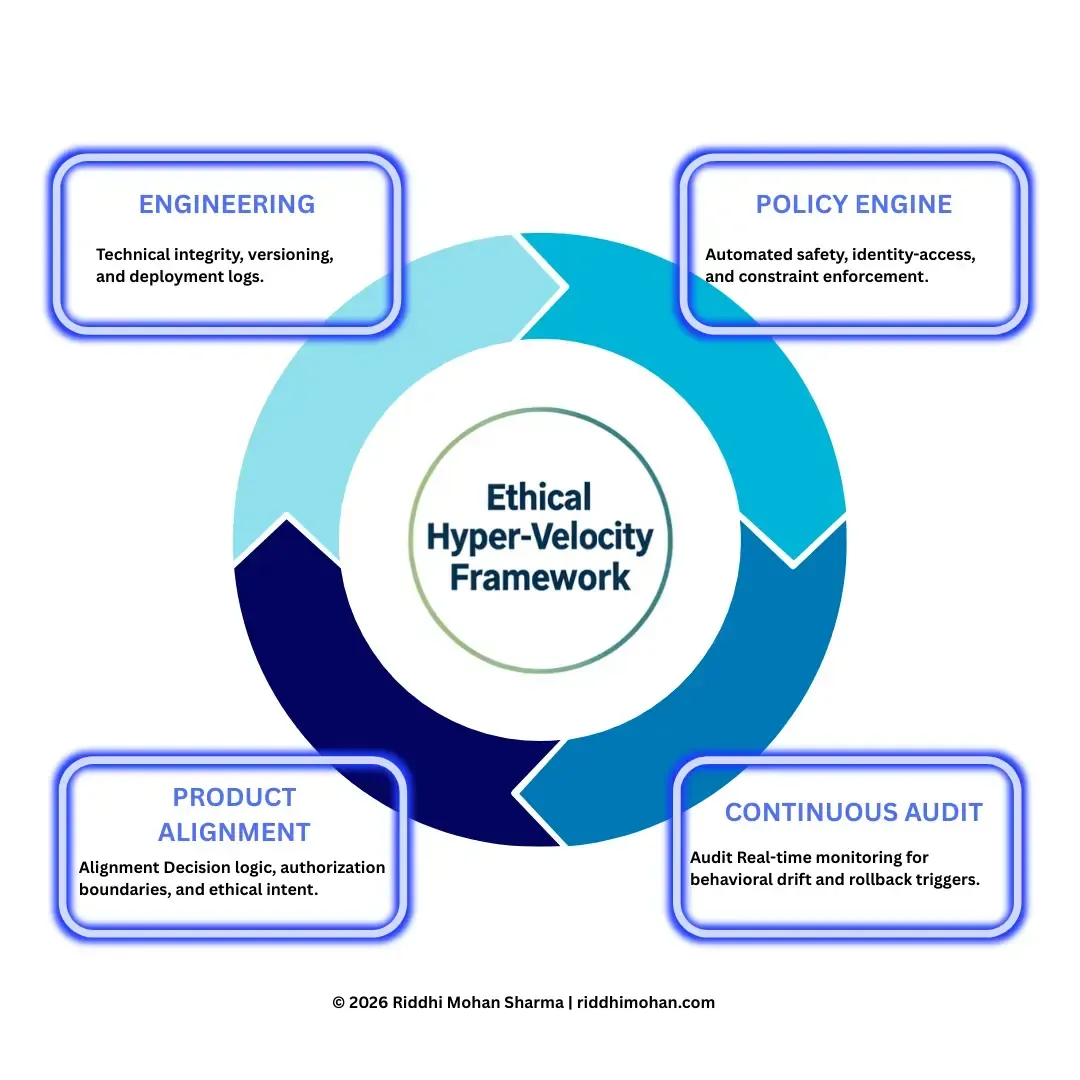
Ethical Hyper-Velocity (EHV): Compiling Governance into the AI Inference Stack
EHV is not a 'policy framework' but a Governance-Aware JIT Compiler that eliminates the 'Governance Latency' inherent in ISO 42001 and human-in-the-loop audits. By compiling governance directly into the inference stack, we move from reactive compliance to proactive, sub-millisecond enforcement.

Riddhi Mohan Sharma
Senior Technology Leader. Global Identity Architecture. M&A Technology Integration. AI Strategy.
Senior Technology Leader specializing in Global Digital Identity Architecture and M&A Technology Integration. Track record across multi-million dollar P&L, AI strategy, healthcare compliance (GDPR/HIPAA), and Identity platforms scaled to 3.5M+ users.
Framework Attribution
Disclaimer:The views, frameworks, and architectures presented here (including Architecture Is Policy / Ethical Hyper-Velocity and HPPIE) are my personal thoughts and original syntheses. They are inspired by and draw lessons from my broad enterprise-scale research and experience in healthcare identity, M&A integration, and AI governance. They do not represent the views, policies, or practices of my employer and are not based on any specific proprietary information, internal systems, code, metrics, or confidential details from my current or past roles. All examples and implementations are generalized or self-hosted on this personal site.