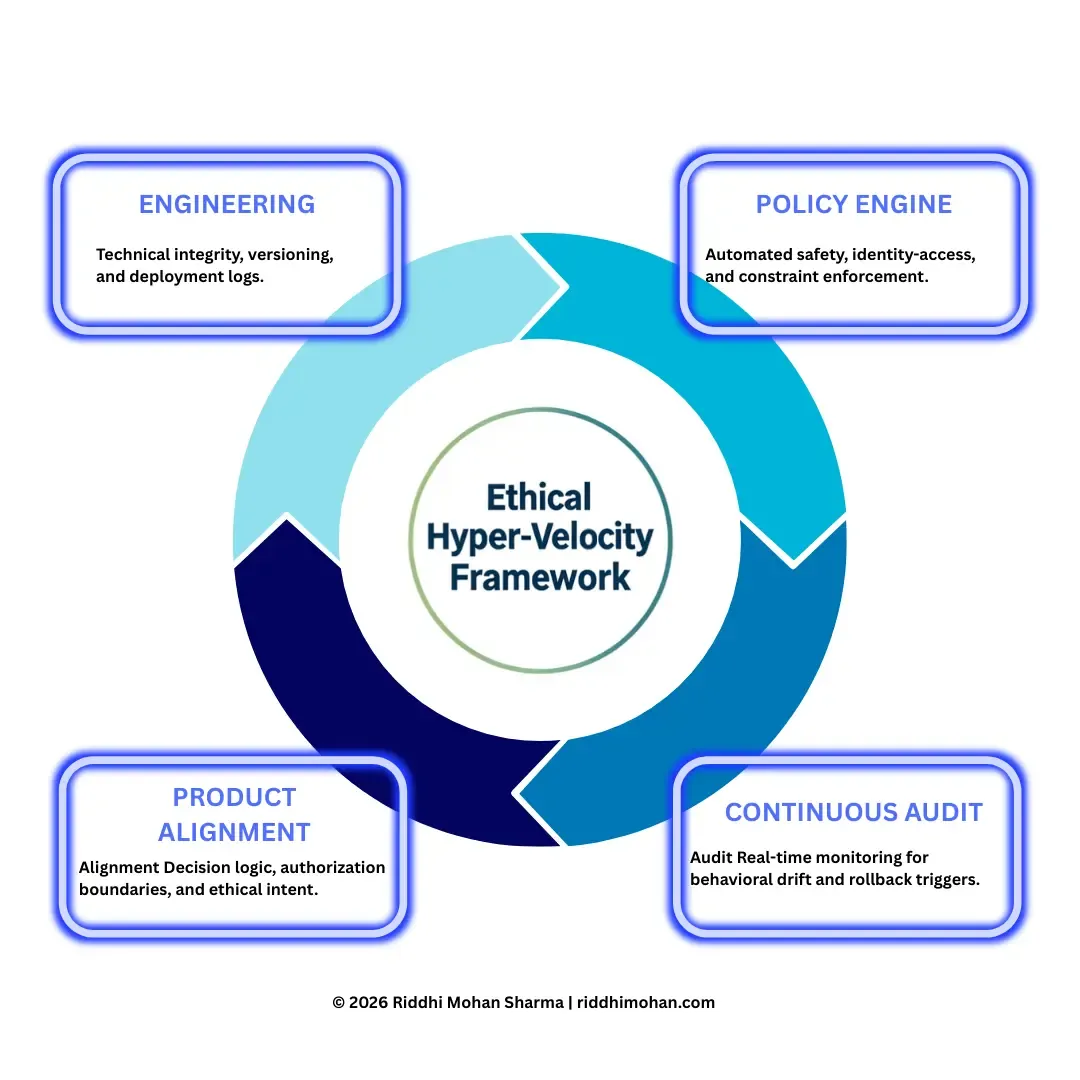
Ethical Hyper-Velocity EHV Governance Framework - The Operating Principle for Agentic Enterprise AI

Every technology era produces an organizing principle that separates organizations that scale from those that stall. In the cloud era, it was build for failure. In the AI era, it is Ethical Hyper-Velocity (EHV).
Figure 1: The Ethical Hyper-Velocity (EHV) Governance Framework. [Ethical Hyper-Velocity (EHV) Governance Framework © 2026 Riddhi Mohan Sharma]
The Core Definition
Ethical Hyper-Velocity (EHV) is the maximization of decision and execution speed, achieved by shifting governance from a manual gate to an immutable, automated architectural constraint. It is the evolution of compliance from a friction-heavy bottleneck into the primary engine of systemic trust.
Ethical Hyper-Velocity (EHV) is an architectural principle that embeds accountability, explainability, and regulatory compliance directly into system design and deployment pipelines. It treats governance not as a gate, but as the mechanism of acceleration.
By automating policy enforcement and audit trails at the design phase, organizations eliminate the rework loops, regulatory collisions, and trust failures that currently paralyze enterprise AI deployments.
Ethical - not compliant. Compliance asks "are we allowed?" Ethics asks "can we justify this to the people it affects?"
Hyper - not fast, but a regime change: the point at which old governance models are structurally inadequate.
Velocity - not speed. Speed is scalar. Velocity is a vector: speed plus direction. Without directional architecture, speed is compounding risk.
Ethical Hyper-Velocity (EHV) draws from organizational theory's "ethical velocity" and engineering's "hyper-velocity" paradigms - but is neither. It is a governance-performance framework: ethical design as a deployment multiplier, not a constraint.
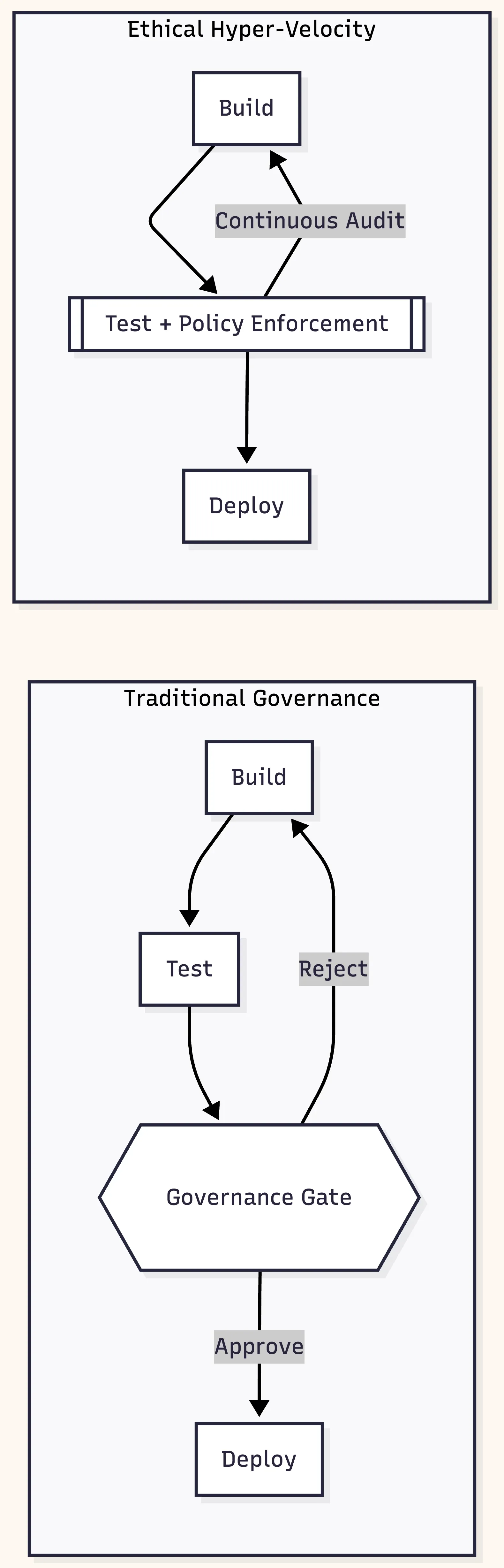
Figure 2: The Ethical Hyper-Velocity (EHV) Pivot. [EHV Framework © 2026 Riddhi Mohan Sharma] Traditional governance treats compliance as a reactive "gate" (bottom), creating systemic bottlenecks. EHV replaces this with an automated, integrated loop (top), turning compliance into a driver of deployment velocity.
Note: Ethical Hyper-Velocity (EHV) is a proprietary governance-performance framework established by Riddhi Mohan Sharma, 2026. All rights reserved.
The Three Pillars of Architectural Accountability
EHV moves oversight from the boardroom to the build system.
1. Policy Enforcement as a Velocity Engine
Traditional governance relies on manual approval - a bottleneck that creates adversarial dynamics between engineering and risk teams.
The goal is clear, integrate automated safety measures, identity and access controls, and policy constraints directly into the CI/CD pipeline.If a model update violates these parameters, the pipeline triggers an automated rejection. Governance becomes a structural guardrail that enables speed, not a human gate that stops it.
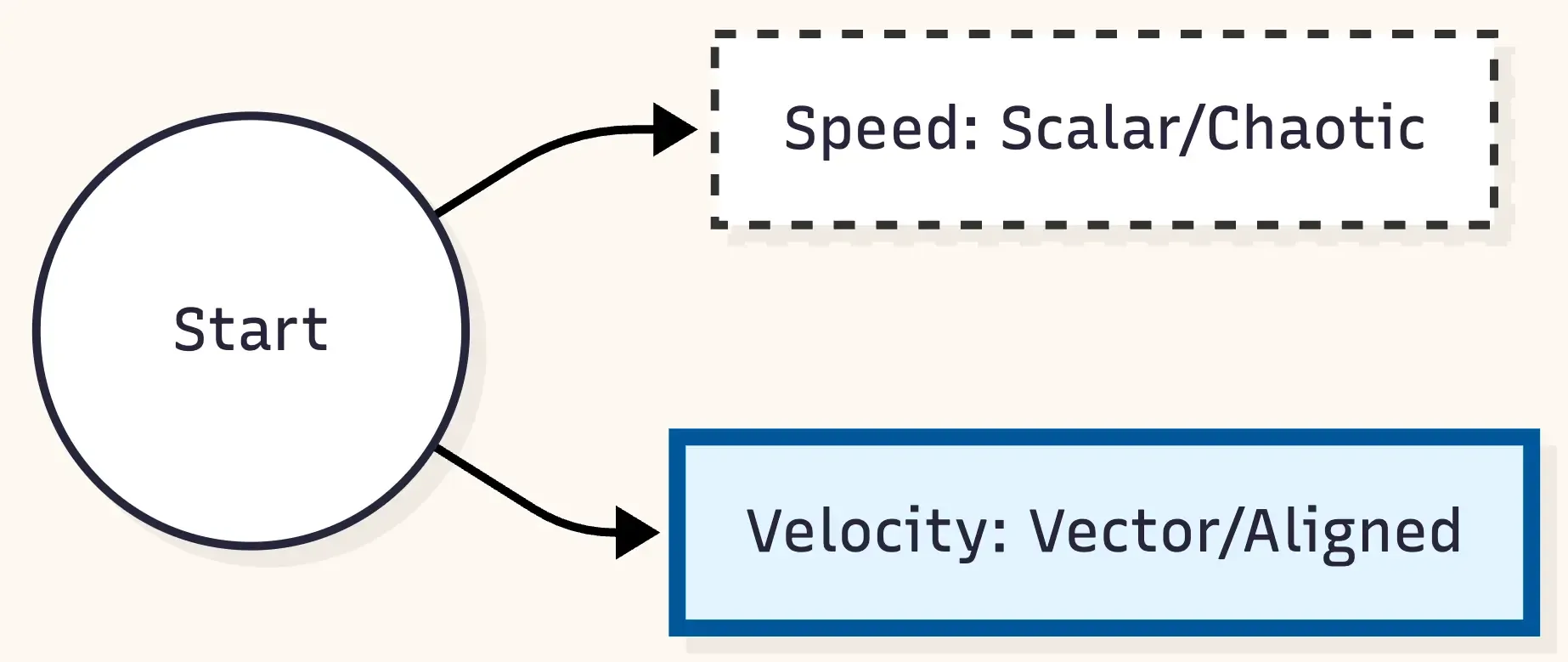
Figure 2: The EHV Continuous Loop. [EHV Framework © 2026 Riddhi Mohan Sharma] Governance is no longer a human-managed checkpoint; it is a real-time, automated engine that validates engineering, logic, and policy at every stage of the build cycle.
2. The Three-Layer Accountability Model
Accountability fails when ownership is ambiguous. EHV defines three clear ownership layers:
- Engineering owns technical integrity: automated logs, deployment audit trails, model versioning
- Product owns decision logic and ethical alignment: what the system is authorized to decide and why
- Governance & Risk owns the policy engine: the rules that the other two layers operate within
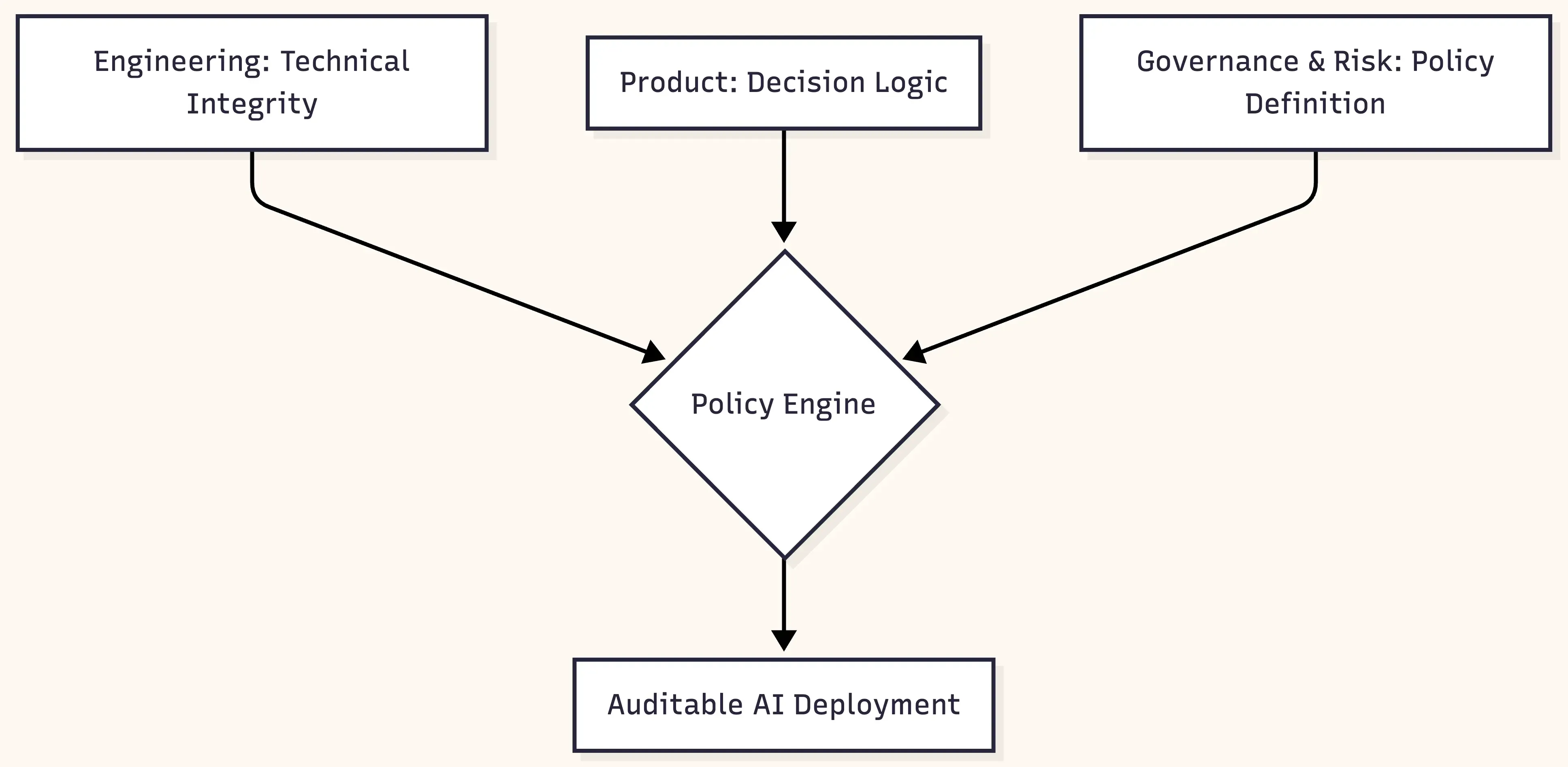
Figure 3: The Tripartite Accountability Stack. [EHV Framework © 2026 Riddhi Mohan Sharma] EHV eliminates "blame-shifting" by explicitly mapping ownership: Engineering ensures technical integrity, Product defines the decision boundaries, and Risk/Governance maintains the automated policy enforcement.
These layers operate simultaneously, turning governance into a continuous stream rather than an episodic event.
3. Continuous Oversight Beyond Design-Time
AI systems are dynamic. Static governance is obsolete.
The Imperative: EHV requires real-time monitoring for behavioral drift. When a system deviates from its authorized decision boundaries, it must trigger an automated rollback. Governance does not end at launch - it runs in production.
The M&A Governance Mandate
In high-velocity M&A, governance debt is often invisible until it is catastrophic. The question that surfaces in every technical due diligence is: Can this system explain what it does, and can we absorb it without inheriting its accountability gaps?
EHV establishes a common policy language that allows acquiring organizations to evaluate and map a target's AI stack against a defined accountability framework during technical due diligence. An AI stack that cannot be audited or mapped to a clear accountability structure is not an asset - it is a contingent liability.
The C-Suite Audit
If your organization cannot answer these three questions in real time, you have speed, not velocity. Speed without direction is a compounding risk.
- Explainability: Can your AI systems explain their decisions to a regulator without a manual forensic audit?
- Structural Integration: Is governance an automated component of your deployment pipeline, or a manual review that happens after the fact?
- Accountability Chains: Is there a verifiable, auditable chain of authorization behind every autonomous action your AI agents take?
The Verdict
Model capability is commoditizing. The differentiator for the next three years is architectural trust - the ability to deploy AI that regulators can audit, boards can defend, and users can rely on, at the speed the competitive environment demands.
Ethical Hyper-Velocity is the framework for building that trust into the foundation. Organizations that embed this principle today will compound their deployment advantage; those that defer it will find that the cost of catching up is the accumulated liability of every unauditable decision their systems made while governance was still "on the roadmap."
Let's Connect
I coined the term Ethical Hyper-Velocity to name a principle I kept observing across fifteen years of building enterprise systems where speed and governance appeared to be in tension and where the organizations that resolved that tension by architectural design consistently outperformed those that resolved it by crisis.
If you are building at the intersection of enterprise AI, identity governance, or regulated industry deployment - Let's talk.
Ethical Hyper-Velocity (EHV) Governance Framework is an original framework established by Riddhi Mohan Sharma, March 2026. Ethical Hyper-Velocity (EHV) Governance Framework © 2026 Riddhi Mohan Sharma. All rights reserved.
Unauthorized reproduction, distribution, or derivative use of this framework in commercial products or training materials is strictly prohibited without written consent.*
Read the Official Ethical Hyper-Velocity (EHV) Governance Framework Usage & Licensing Policy
Riddhi Mohan Sharma is a Technology Leader and Engineering Executive specializing in global identity platforms, enterprise AI governance, and M&A technical integration. Co-Author, "Mastering Jenkins" (Packt Publishing, 2015). 2nd place, Internet Brands Global AI Hackathon, 300+ participants (2025). Active contributor, IEEE, IEEE Computer Society, IEEE EMBS, and Cloud Security Alliance.
First published March 9, 2026 at riddhimohan.com